Loading...
Back to Blog
Back to Blog Dan Malone
agent-desktop Shipped Four Releases in a Week, So My Machines Update It Themselves Now
Dan MaloneNovember 4, 2026
4 min read
View Source Code
github.com/Danm72/agent-desktop-autoupdate
Connect on LinkedIn
in/d-malone
Follow on Twitter/X
@danmalone_mawla
Share this article
TL;DR
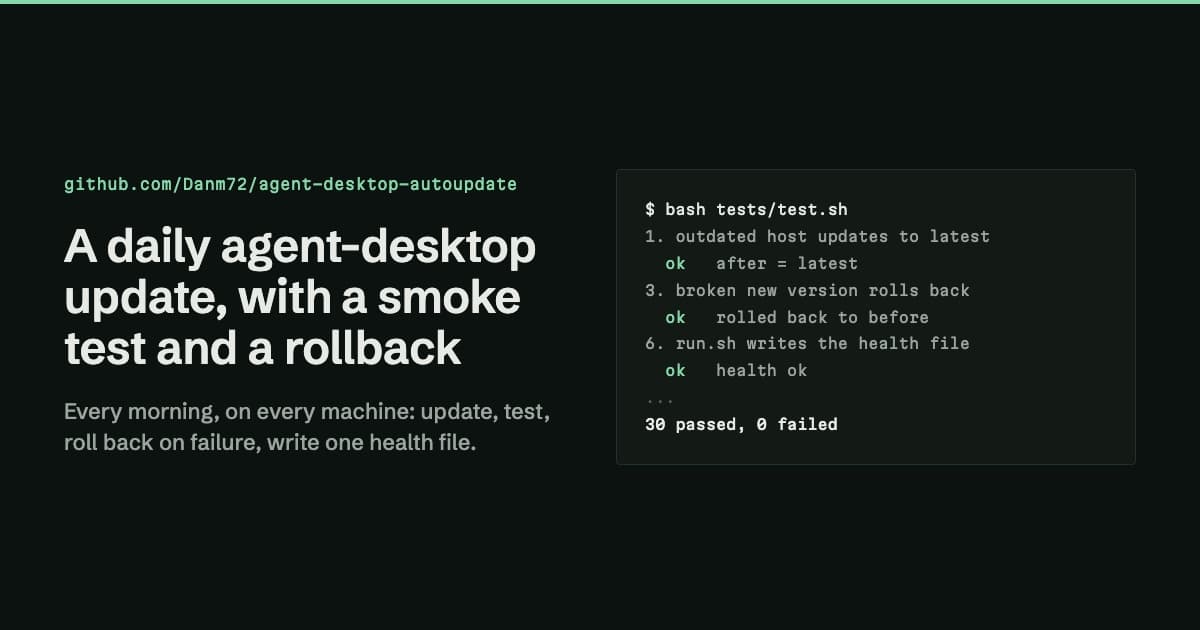
The tools that AI agents use now change every week. agent-desktop shipped four releases between 28 Oct and 3 Nov. I run it on two machines, and I don't want to track versions by hand. So a daily job updates it on both and tests it. If the test fails, the job rolls it back. Then it writes one file that says if it worked. The code is free on GitHub.
agent-desktop Shipped Four Releases in a Week, So My Machines Update It Themselves Now
My AI agents use agent-desktop on my Mac and on a Linux box. It's a command-line tool from Vercel Labs. It lets agents use desktop apps through the accessibility tree. That's the same interface screen readers use, so an agent can read a window and press its buttons.
It moves fast. These are the releases from the last week:
| Version | Date |
|---|---|
| v1.0.0 | 28 Oct 2026 |
| v1.0.1 | 28 Oct 2026 |
| v1.0.2 | 30 Oct 2026 |
| v1.1.0 | 3 Nov 2026 |
Why I care which version is on which machine
The usage guides for agents are built into the binary. An agent runs agent-desktop skills get desktop and gets the guide for the version it has. That's good, because the docs always match the tool.
It also means a machine that falls behind gives its agents an older guide. With two machines, you can get two different behaviours for the same task. Then you debug the agent when the real cause is the version.
An update is a small job. But a small job that I have to remember is one I'll forget. So I gave it to a scheduled job.
What the job does
Every morning a scheduled job runs on my Mac. For each machine it does these steps:
- Read the installed version and the latest version on npm.
- Stop if they're the same.
- Install the latest.
- Do a smoke test. The version has to match, the built-in guide has to print and
agent-desktop statushas to report OK. - If the install or the test fails, put the old version back.
The Linux box gets the same script over SSH, so it doesn't need a copy of the repo. Then the job writes one health file with a line for each machine. If a machine failed, or the job didn't run at all, I can see it at a glance.
The first run
The first real run was on 4 Nov. It moved the Mac and the Linux box from 1.0.2 to 1.1.0. A second run reported both machines as current.
On the Mac I checked one more thing. macOS gives the Accessibility and Screen Recording permissions to the terminal app that runs agent-desktop, not to the binary itself. So the update kept both permissions. I checked that with agent-desktop permissions after the update.
The repo has 30 automated checks. They use fake npm and agent-desktop commands, so they need no network and don't touch the real install. They cover an update, a machine that's current and a rollback after a broken release. They also cover npm down, a machine the job can't reach, the config file and the lock that stops two runs at once.
What it doesn't do
- It installs whatever npm says is the latest. It doesn't wait a day to see if a release gets pulled. The smoke test is the only guard.
- The smoke test checks that the tool starts and reports OK. It doesn't run a real agent task. A release that breaks one app could still pass.
- It doesn't do the first install. agent-desktop has to be on the machine already.
- Each remote machine needs an SSH key login that works with no prompt.
For my setup that's a fair trade. The job rolls back a release that fails the smoke test. The health file tells me about it the same morning.
The bigger point
If you run AI agents in your business, the tools under them now change every week. Someone has to own the updates.
For me, that's a scheduled job with a test, a way back and a file I can check. It's one less thing on my list, and both machines stay on the same version.
The code is on GitHub at github.com/Danm72/agent-desktop-autoupdate. It works on macOS with launchd and on Linux with a systemd timer. It's MIT licensed, so take it, change it and use it.
Explore the Full Code
Star the repo to stay updated
Let's Connect
Follow for more smart home content
Follow on Twitter/X
@danmalone_mawla
Tags
agent-desktop
ai-agents
automation
open-source
macos
linux

Related Articles
Continue reading similar content

No CMS, Just WhatsApp: The Jamie Skelton Website
Jamie Skelton is a Dublin wedding and corporate magician. His website has no CMS. He edits it by chat on WhatsApp, and a bot called SKELTRON turns each message into a tested, live change. In 3 days the site went from 12 pages to 167.
9 min read

AI Agents Built My Game in Godot, Then Ported It to Unity. Here's What I Learned
I'm building Crush Depth, a deep-sea salvage game, and AI agents write all of the code. It started in Godot 4.7, and this week the full port to Unity 6.7 got under way. Here's how I picked the engine, the numbers behind the call, and what made the agents useful.
7 min read
I Replaced CleanShot X With a Free Screenshot App I Built in One Session
A free, open-source screenshot app for the Mac. I take screenshots all day, and that meant CleanShot X. This week I replaced it with FreeShot, which I built in one session with Claude Code. Here's what it took, what it cost and what I gave up.
5 min read