Loading...
Back to Blog
Back to Blog Dan Malone
I Built an AI Staff to Run My Business. Here's the Full System.
Dan MaloneFebruary 26, 2026
14 min read
Share this article
TL;DR
I've been running my business with AI agents for months — five of them, each handling a different part of operations. Admin, insights, revenue, content, strategy. Every time I showed someone the setup, the reaction was the same: "How do I get this?" Here's what Mission Control actually does, how it works under the hood, and what it takes to build the same thing for another business.
I Built an AI Staff to Run My Business. Here's the Full System.
I built it to stop drowning in operations.
Client follow-ups slipping. Pipeline going cold. Content ideas evaporating after every call. The kind of operational drag that eats your morning before you've done any real work.
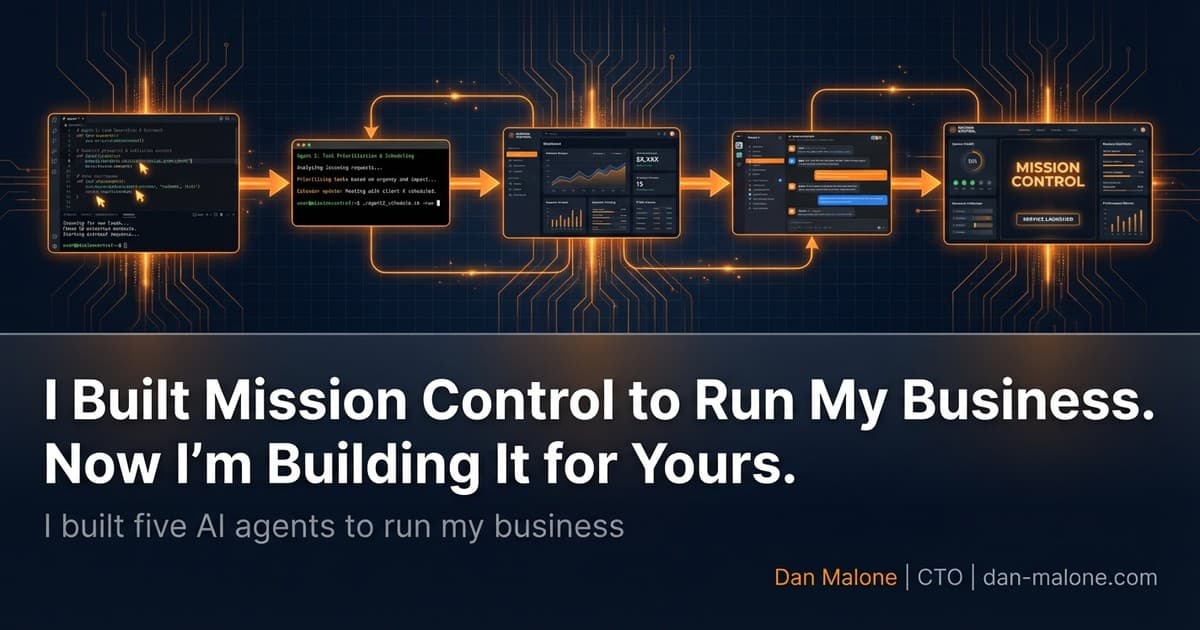
So I built a system. Five AI agents, each owning a piece of my operations, running 24/7 through Telegram and Claude Code. I called it Mission Control.
After a few months of running it, I started showing people. Not as a pitch — just pulling up my phone and walking through the outputs. The reaction was always the same: "How do I get this for my business?"
Enough people asked that I now build the same kind of system for other businesses — as AI workflow automation projects, scoped to your operations and your tools.
What Mission Control Actually Is
If you've been following the blog, you've seen the pieces come together:
- Mission Control: Give Your OpenClaw Agent a Team — the concept and early architecture
- How to Build Your Own AI Mission Control with OpenClaw and Telegram — the full technical build guide
- Ralph Wiggum: Orchestrating AI Agents to Migrate a Codebase — parallel agent orchestration in practice
- OpenClaw Gave My Home Assistant an AI Agent — persistent agents with personality and memory
Mission Control is the system those posts describe, running in production. Five AI agents, each with a specific job, coordinating through a Telegram forum, supervised by me.
Here's what my setup looks like on a typical day:
| Metric | Value |
|--------|-------|
| Agents running | 5 |
| MCP servers connected | 8+ (Notion, Granola, Gmail, Calendar, Drive, search, browser, domain lookup) |
| Files touched per processed call | ~9 |
| Notion tasks auto-created per call | ~6 |
| Transcripts analyzed for voice profile | 119 |
| Sessions analyzed for burnout mapping | 200+ |
The Five Agents
These aren't theoretical. They run every day. Here's what each one actually does.
1. The Ops Manager
Email triage, scheduling prep, Notion updates, follow-ups. The two hours of admin that eats your morning.
This is the agent with the broadest tool access. On a single check-in, it can touch Gmail, Calendar, Notion, Granola meeting notes, and other agents. When someone asks "what can this thing actually do?", the Ops Manager's tool inventory is the answer — it's connected to everything.
Starting here is the move. For every client, the Ops Manager is agent #1. Lowest friction, highest immediate ROI. You feel the difference on day one.
2. The Signal Agent
This is the one that gets the biggest reaction when I demo it.
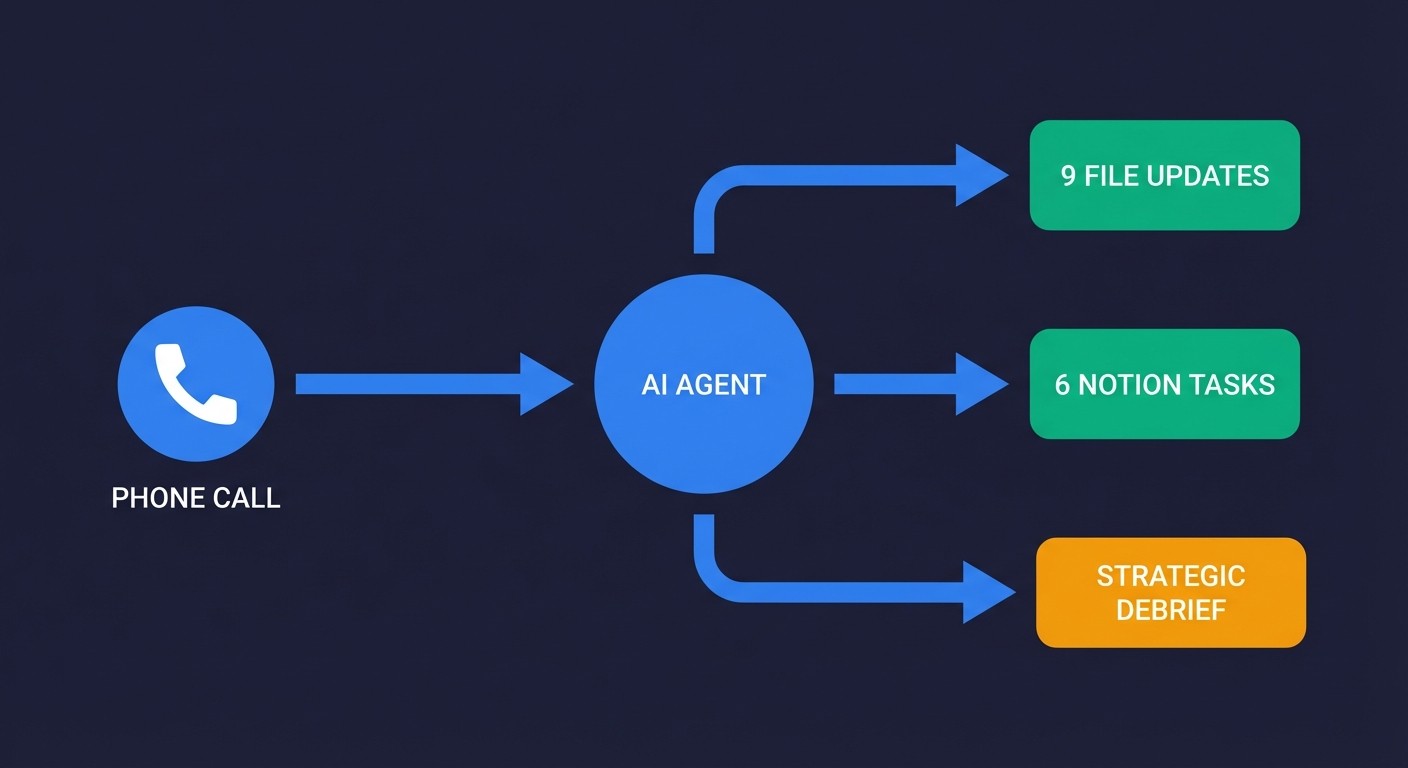
After a single discovery call, here's what the Signal Agent produced automatically:
- 9 file updates: meeting notes written, client context files updated, Dan's self-assessment appended, pipeline stage moved from Discovery to Negotiation, lead status updated
- 6 Notion tasks created: with timeframes, energy levels, and priority tags — "Review BetMode docs" (This Week, Deep Work), "Schedule follow-up scoping call" (This Week, Waiting On), "Reflect on discovery call anxiety" (This Week, Deep Work)
- A full strategic debrief: separating emotion from fact, naming a pre-call anxiety pattern worth addressing, identifying a real gap in service packaging, and offering three concrete next actions
One call. Zero manual work. The agent didn't just transcribe — it understood.
The debrief is the killer feature. The Signal Agent doesn't just summarize your calls. It coaches you through them. It names patterns, challenges assumptions, and surfaces things you'd miss because you're too close.
3. The Revenue Partner
Here's the thing about CRM follow-ups: everyone knows they should do them, nobody does them consistently.
The Revenue Partner handles lead enrichment, pipeline tracking, and email drafting — all in your voice. Not generic AI voice. Your voice.
How? I build a Tone of Voice Guide from your actual conversations. Mine was built from 119 real meeting transcripts spanning mid-2023 to February 2026. It knows my signature words ("Super" is my #1), my primary connector ("You know"), my softeners ("Sort of/Sorta"). When it drafts an email, it sounds like me.
Here's a real example. I asked my agent to draft an email to a client using the recent changelog:
"So I know I said Monday, but I got most of the updates done today and figured why wait."
Casual, specific, human. Not "Dear Kyla, I hope this email finds you well." The client gets an email that sounds like Dan, because the agent writes like Dan.
4. The Content Engine
You're reading its output right now.
Meeting transcripts become blog post ideas. Client conversations (anonymized) become case studies. My expertise gets published without me staring at a blank page.
The Content Engine handles research, drafts, image generation, social media posts, and publishing coordination. The previous post about building Mission Control in Telegram — the Content Engine managed the research, the draft iterations, and the social distribution.
5. The Strategic Advisor
This is the one that blew my own mind.
I asked it to analyze 200 coaching calls spanning two years and reconstruct my burnout experience from closing my last business. What came back was a timeline — "The Burnout Arc" — drawn from 19 solo reflection sessions, 16 team 1:1s, 11 client calls, 11 standups, and 30+ external meetings.
It described the burnout as "a slow dimming, not a collapse." It tracked the emotional trajectory across months. It identified the root cause: "a product person who built an agency."
The seeds were planted in fundamental misalignment — a product person who built an agency.
For coaches working with clients, imagine offering this: a longitudinal analysis of emotional trajectory across dozens of sessions. That's not admin automation. That's augmented intelligence.
How It Works Under the Hood
The architecture has three layers:
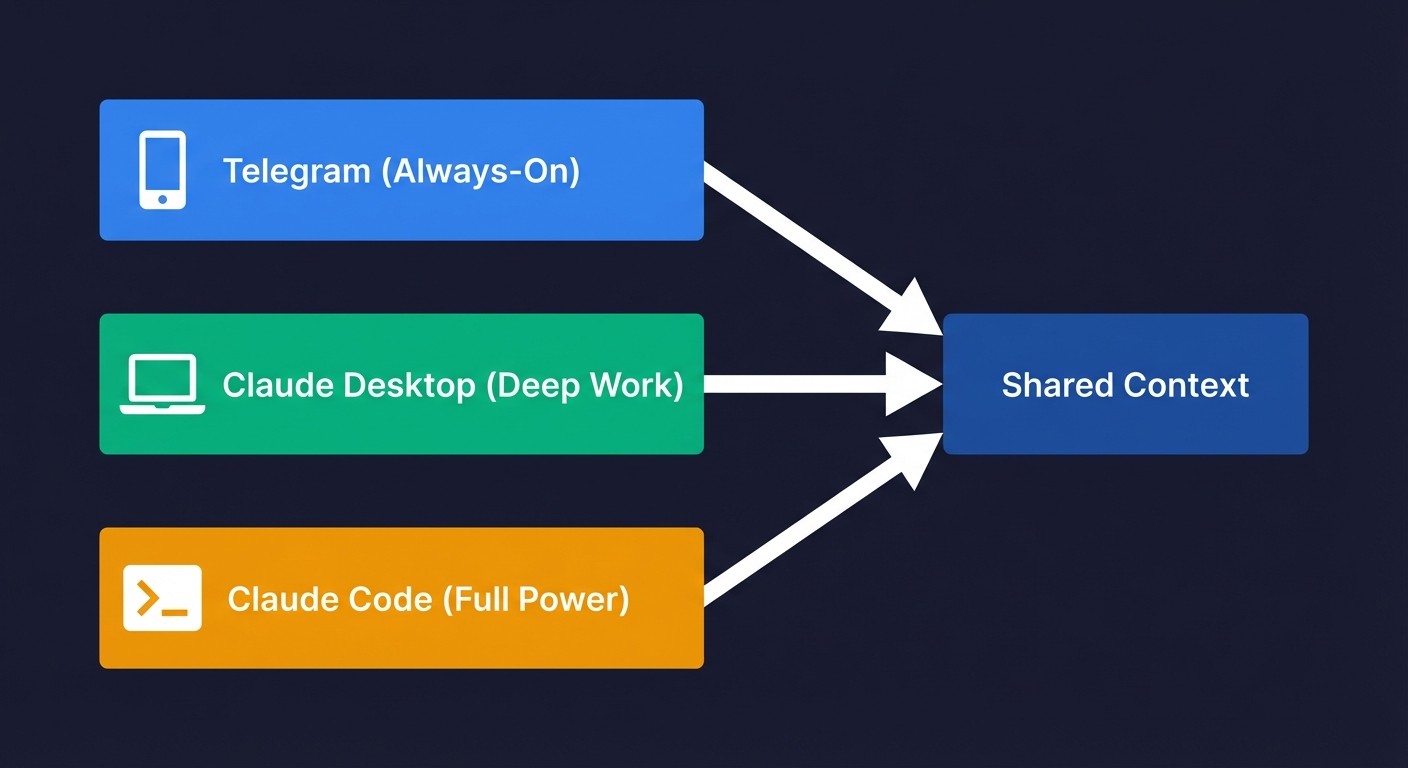
Each agent lives in a Telegram forum topic. They check in on heartbeat schedules, surface things proactively, and you message them from your phone. This is Mission Control's home base.
Layer 2: Claude Desktop (Deep Work)Same agent context, GUI interface. For clients who want more hands-on interaction — transcript analysis, strategy sessions, multi-step research.
Layer 3: Claude Code (Full Power)CLI, parallel execution, skills, swarms. This is where the Signal Agent processes calls, where the Strategic Advisor analyzes 200 sessions, where the heavy computation happens.
All three layers share context through MCP servers and git-synced workspaces. The agent you message on your phone at breakfast is the same agent doing deep analysis on your laptop at your desk.
01
The Setup Process
02
Week 1: Discovery — I map your workflows, tools, communication style, and pain points. We identify which agents you need first (usually starting with the Ops Manager).
03
Week 1-2: Build — I configure your agents, connect your MCP servers (CRM, calendar, email, Notion, whatever you use), build your Tone of Voice Guide from actual conversations, and set up your Telegram Mission Control forum.
04
Week 2: Launch — Your agents go live. I supervise them, tune their behavior, and ensure nothing goes sideways.
05
Ongoing: Supervision — Weekly reviews, continuous agent tuning, MCP server maintenance (token refresh, OAuth, connection health). This is the moat — keeping AI agents reliably running is non-trivial.
The Part People Underestimate
You could build this yourself — I literally wrote the step-by-step guide. But there's a difference between setting it up once and keeping it running reliably.
MCP servers need maintenance. Tokens expire. APIs change. Agents drift from their SOPs. Someone needs to watch the system, tune it, and fix things when they break at 2am.
That's the real work. The setup is a project; the reliability is a discipline.
Warning
This isn't for everyone. If you're spending less than 10 hours a week on operations, you probably don't need this yet. If you want to tinker and build it yourself, the Telegram build guide is free. If you want it built properly and handed over running, that's what my AI workflow automation work covers.
How It Works
The exact setup is scoped to your workflows — how many agents, which tools they connect to, and how much supervision your operation needs. We talk through what you're running and I build the system around it, with no obligation to sign up.
The Blog Post Series
This post is part of a series documenting the evolution from personal experiment to production system:
Part 5
The Mission Control Series
1. OpenClaw Gave My Home Assistant an AI Agent — Where it started: persistent agents with personality
- Mission Control: Give Your OpenClaw Agent a Team — The concept: agent squads coordinating as a team
- Ralph Wiggum: Orchestrating AI Agents to Migrate a Codebase — Parallel agent orchestration in practice
- How to Build Your Own AI Mission Control with OpenClaw and Telegram — The full technical build guide
I Built an AI Staff to Run My Business. Here's the Full System. ← You are here
What's Next
The first client builds are underway — Admin Agent first, then Signal, then Revenue. I'll document the process and share what works, what breaks, and what surprises us.
If you've read the blog posts, seen the screenshots, and thought "I want this for my business" — that's exactly who this is for.
Info
See AI Workflow Automation →
Or just tell me what's eating your time. I'll map the system from there. No obligation. Async by default.
🤖 AI Workflow Automation
This is exactly what my AI workflow automation work delivers: AI agents configured to your workflows, connected to your tools, built by the person who runs this system in production. Learn more →
Explore the Full Code
Star the repo to stay updated
Let's Connect
Follow for more smart home content
Follow on Twitter/X
@danmalone_mawla
Tags
ai
openclaw
mission-control
ai-staff
multi-agent
claude
automation

Related Articles
Continue reading similar content
I Replaced CleanShot X With a Free Screenshot App I Built in One Session
A free, open-source screenshot app for the Mac. I take screenshots all day, and that meant CleanShot X. This week I replaced it with FreeShot, which I built in one session with Claude Code. Here's what it took, what it cost and what I gave up.
5 min read
Every Monday I Type /mission — 9 Claude Code Skills That Run My Business
I built 9 Claude Code skills to keep my one-person portfolio business oriented around goals, KPIs, and the actions that actually move them. Here's how the whole system works.
12 min read
AI Agents Built My Game in Godot, Then Ported It to Unity. Here's What I Learned
I'm building Crush Depth, a deep-sea salvage game, and AI agents write all of the code. It started in Godot 4.7, and this week the full port to Unity 6.7 got under way. Here's how I picked the engine, the numbers behind the call, and what made the agents useful.
7 min read