Loading...
Back to Blog
Back to Blog Dan Malone
How to Build Your Own AI Mission Control with OpenClaw and Telegram
Dan MaloneFebruary 18, 2026
18 min read
Share this article
TL;DR
I already had powerful Claude Code folders for deep work at my desk — accounts, tasks, home automation, each with its own
CLAUDE.md and MCP servers. What I didn't have: access to those same contexts from my phone, agents that run while I sleep, and agents that talk to each other. OpenClaw + Telegram adds all three without replacing what already works. Here's the step-by-step guide, including every config example and bug fix along the way.How to Build Your Own AI Mission Control with OpenClaw and Telegram
In my last post, I explored the idea of Mission Control — a coordination layer for AI agent squads. I built a dashboard spike with Kanban boards, heartbeats, and squad state. It helped me think clearly, but it exposed the wrong bottleneck.
What Dashboards Don't Solve
I looked at the landscape — Zapier, Make, Lindy.ai, Relevance AI, n8n — plus a lot of indie dashboard experiments that fizzled out.
The question that cut through it:
What does a dashboard give me that I don't already get from running Claude Code locally?
For my setup, not much. I already had visibility via terminal output, session logs, and git history.
What I actually lacked was:
- Agents that keep running when I leave my desk
- Access to those same contexts from my phone
- A clean way for specialist contexts to talk to each other
The gap wasn't "coordination UI." It was persistence + mobile access + cross-agent collaboration.
The Reality: Great at the Desk, Weak Off-Desk
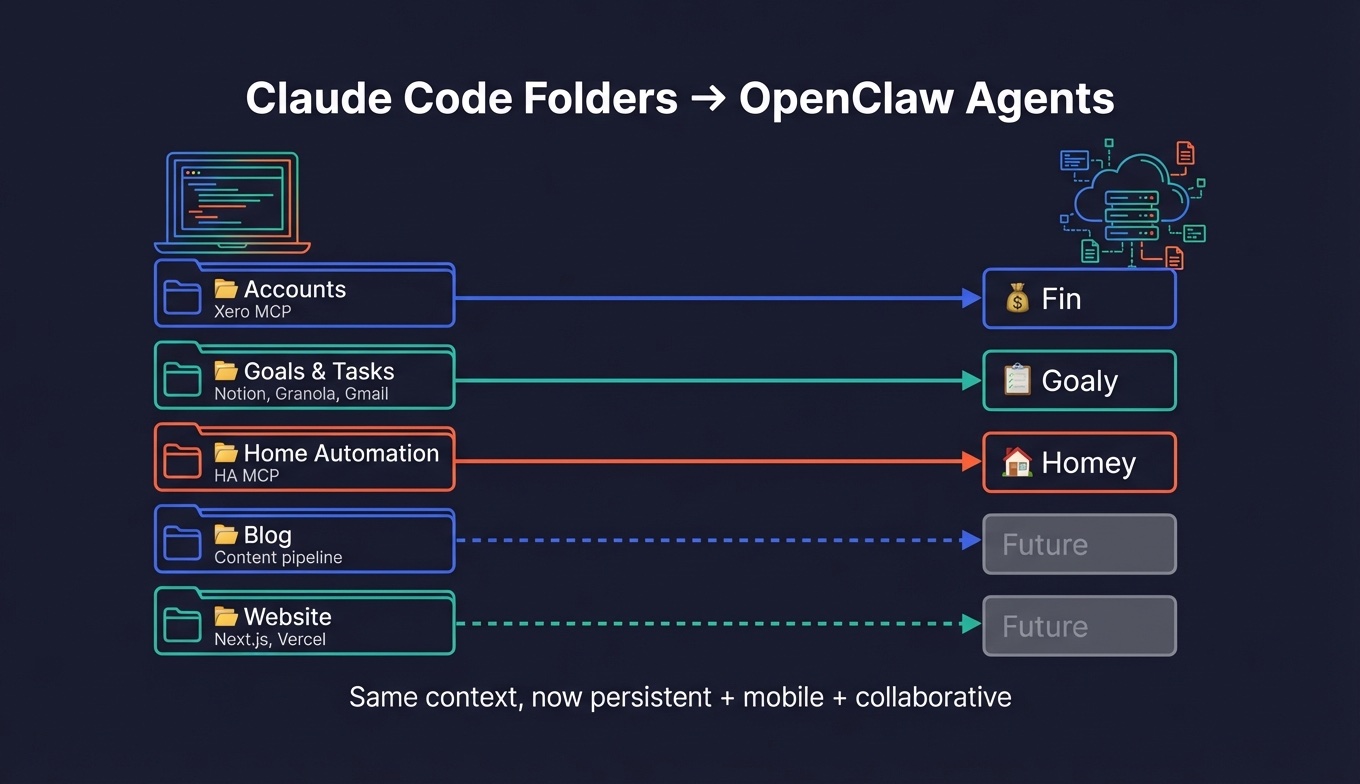
Here's the current setup on my laptop. Each folder is a git repo with a CLAUDE.md, MCP servers, and supporting code:
| Folder | Purpose | Key Tools | OpenClaw Agent |
|---|---|---|---|
| Accounts | Bookkeeping, invoicing, reconciliation | Xero MCP | 💰 Fin |
| Tasks & Goals | Client management, task tracking, planning, SOPs | Gmail, Notion MCP, Granola MCP, calendar CLI | 📋 Goaly |
| Home Automation | Smart home control, automations, sensors | Home Assistant MCP | 🏠 Homey |
| Blog | Content pipeline, drafts, publishing | Content skills, git | — (future) |
| Website | dan-malone.com dev and deployment | Next.js tooling, Vercel | — (future) |
CLAUDE.md mapping Notion databases, schemas, and workflows. At the desk, it's savage. Claude can triage inbox, flag overdue tasks, prep calls, and draft weekly plans.
For deep work, this setup is exactly what I want: terminal-first, high-context, and flexible.
The friction starts when I'm away. I want to check status from my phone, get overdue alerts, or run Monday planning before coffee. I also want Goaly to ask Homey a question without me acting as the middleman.
The Mental Model Shift: One Context, Three Modes
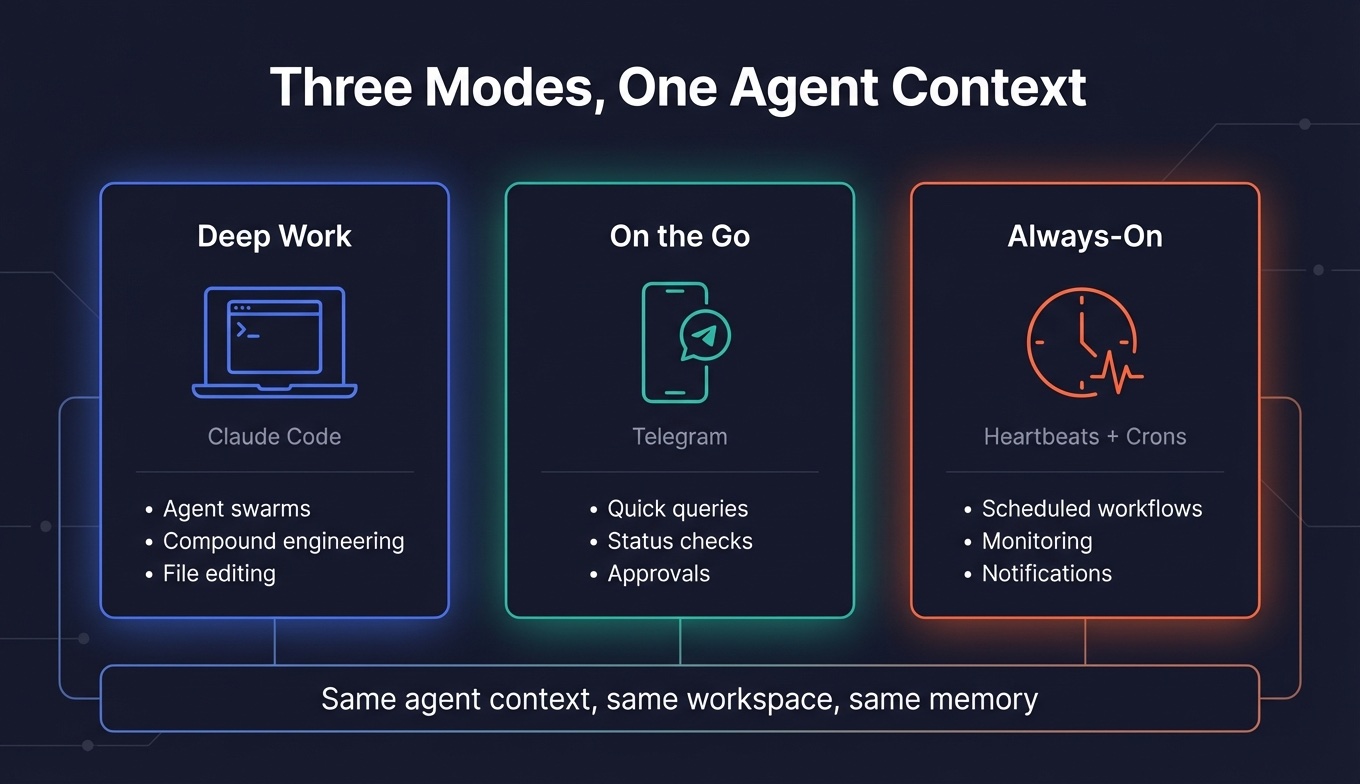
| Mode | When | Interface | What You Get |
|---|---|---|---|
| Deep work | At the desk | Claude Code terminal | Agent swarms, compound engineering, brainstorm/plan/work workflows, file editing |
| On the go | Away from desk | Telegram on phone | Quick queries, status checks, approvals |
| Always-on | 24/7 | Heartbeats + crons | Scheduled workflows, monitoring, notifications |
At the desk, Claude Code still does the heavy lifting.
On the go, the same context is available in Telegram.
Always-on handles scheduled work whether I'm online or not.
And there is one capability that's genuinely new: cross-context collaboration. OpenClaw agents can message each other with sessions_send, so Goaly can ask Homey for a quick check instead of waiting for me.
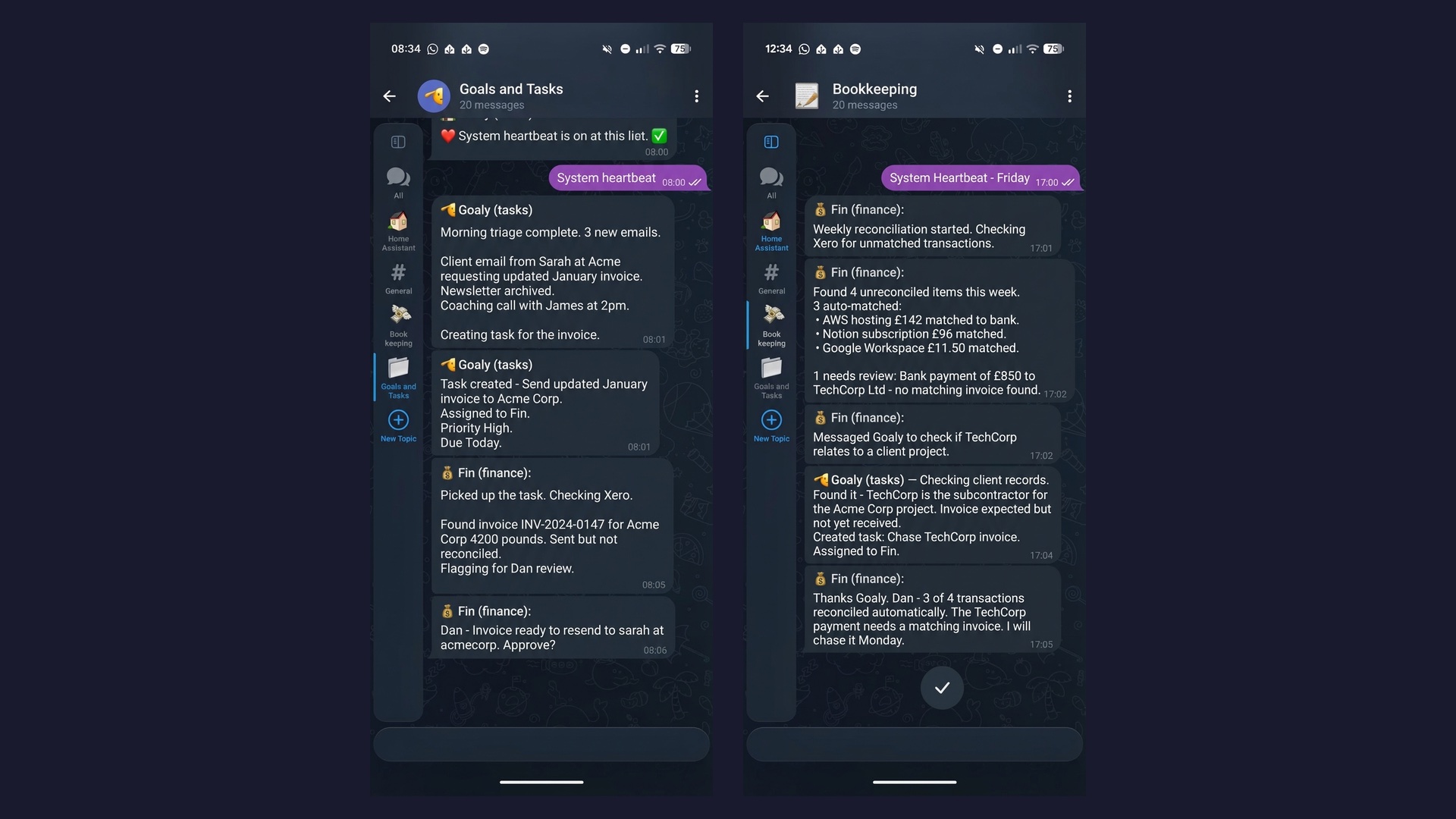
Here's what the always-on mode looks like in practice — two agents handling their scheduled workflows overnight:
Why OpenClaw Fit This Setup
I'd been running Claudette 🦝 on OpenClaw since January for smart-home control. When I expanded to multiple specialists, these were the features that mattered in practice.
Telegram Support Is Actually Usable
OpenClaw has native Telegram support:| Feature | What It Means |
|---|---|
| Forum supergroup support | Each agent gets their own topic thread |
| Multi-account | Multiple bots in one group, routed to different agents |
| DM and group policies | Control where each bot responds |
| Streaming responses | Partial message updates as the agent thinks |
| Media handling | Images, documents, voice messages |
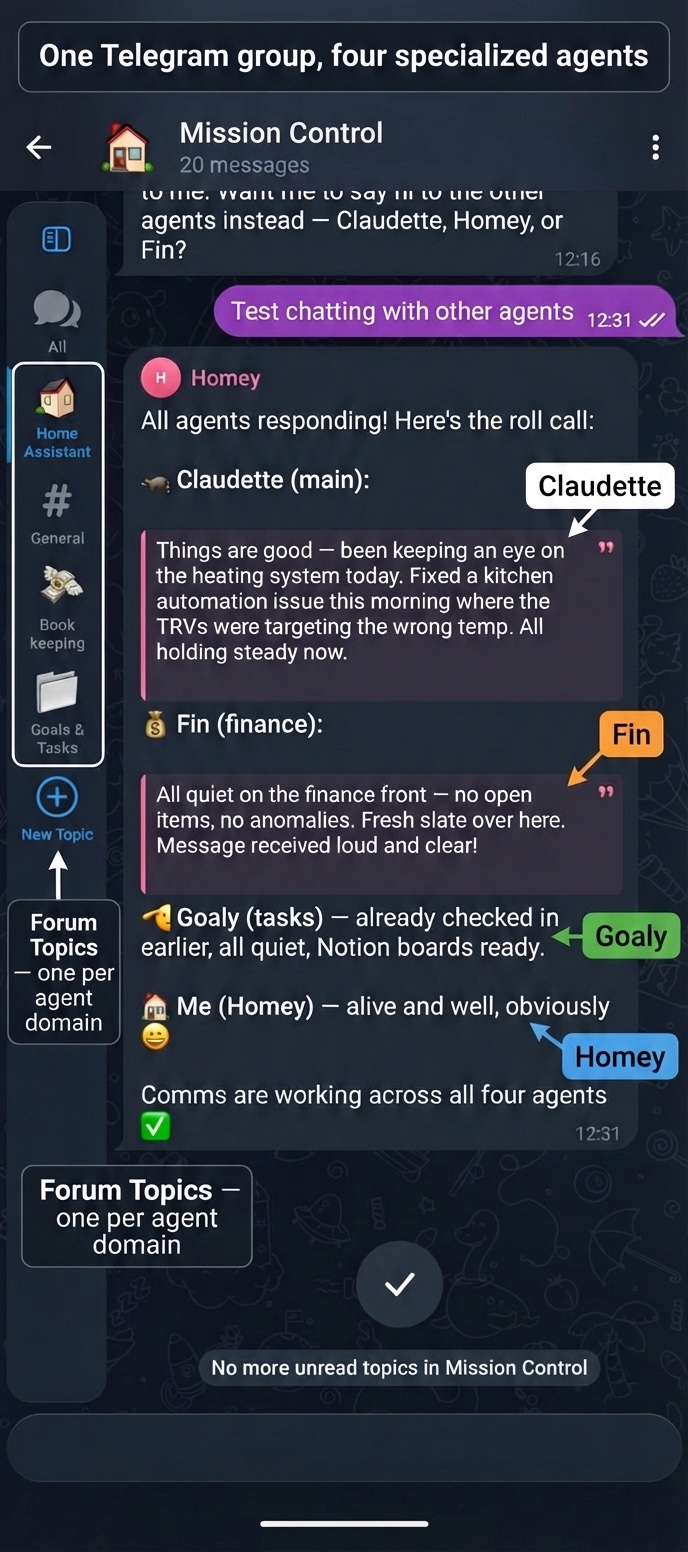
Forum topics made this sane. Instead of one noisy group chat, each bot owns a topic. Homey lives in Home. Goaly lives in Tasks. You jump to the thread you need and talk to the right agent.
Routing Is Predictable
Bindings match on channel, account, peer, guild, and team — most-specific-wins. Each agent gets:- Isolated workspace with its own
SOUL.md, memory, and session store - Per-agent tool lists and model selection
- Its own auth profile and secrets
- Clear routing — no ambiguity about who handles a message
Always-On Is Built In
This is what made my dashboard spike redundant. OpenClaw already includes persistence:
| Mechanism | Use Case | Example |
|---|---|---|
| Heartbeats | Routine monitoring at configurable intervals | Check sensors, flag anomalies |
| Cron jobs | Scheduled rituals (isolated sessions, configurable model) | Monday planning, daily inbox triage |
| Hooks | Event-driven triggers | Respond to webhooks, process incoming data |
MCPorter Reuses Existing MCP Servers
MCPorter (skill) is how OpenClaw agents access MCP servers. Same servers you use from Claude Code locally — Notion, Granola, custom tooling — but accessible to persistent agents via an exec-based bridge:mcporter call notion.query_database '{"database_id": "abc123"}'So I could keep my existing MCP investments instead of rebuilding tooling.
Agent-to-Agent Is Explicitly Controlled
Agents can talk to each other via sessions_send, but only if explicitly allowed in the agentToAgent config. You control who can message whom. No agent goes rogue broadcasting to siblings it shouldn't know about.
What I learned: the highest-leverage layer was persistent agents with clear routing, not another UI to watch them.
Info
How to read the rest: if you want the fast path, read Preflight + Step 1 + Step 2 + Key Takeaways. If you're implementing this in production, read the bug section too.
The Implementation: Building the Team
Enough philosophy. Here's exactly how I set it up.
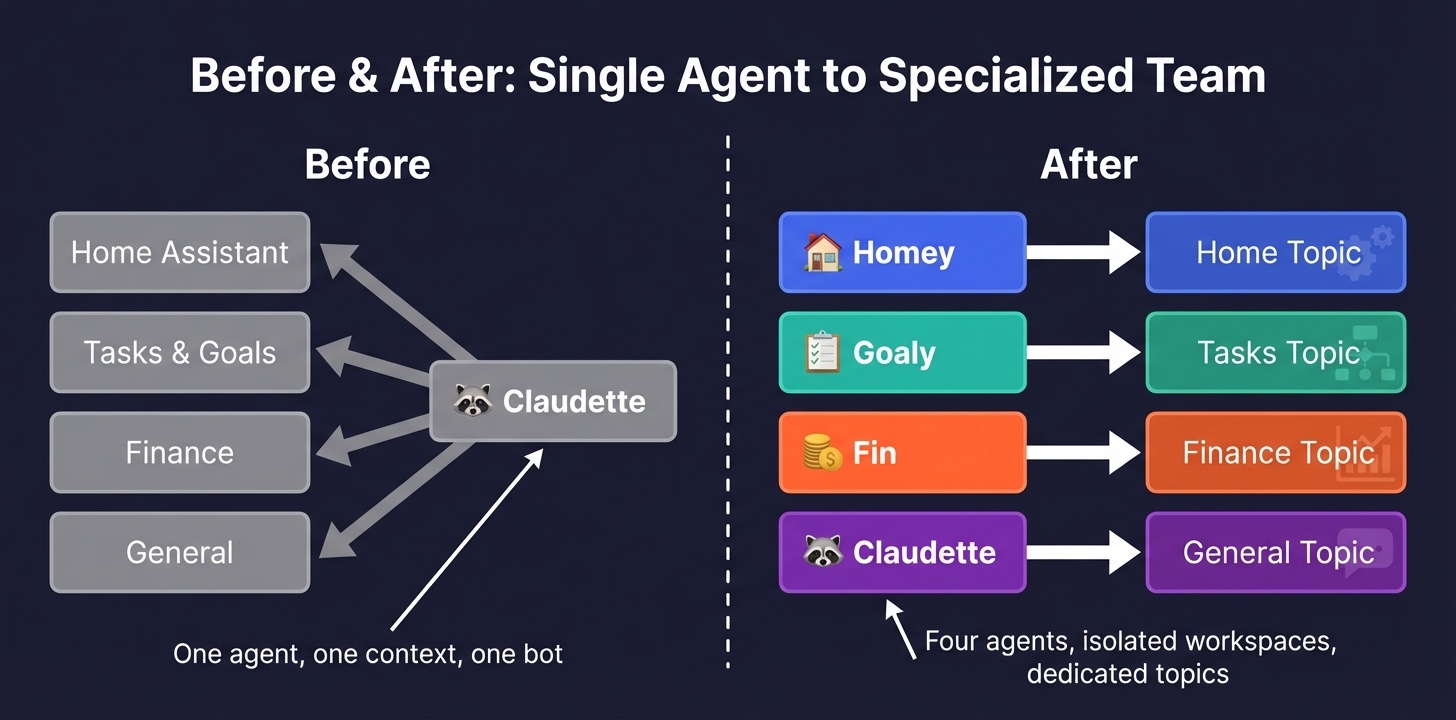
The starting point: a single Claudette 🦝 agent running on OpenClaw inside a Proxmox container. One Telegram bot, one massive context, one set of tools. As OpenClaw added multi-agent routing features, the opportunity became clear — split Claudette's responsibilities into specialized agents.
The first decision was architectural: multiple Telegram bots (one per agent) vs. one bot with per-topic system prompts.
Multiple bots won:
| Factor | Single Bot | Multiple Bots |
|---|---|---|
| Isolation | Shared context, shared sessions | Own workspace, own sessions |
| Identity | One name in chat | Each bot has its own @mention |
| Tooling | All tools loaded always | Domain-specific tools per agent |
| Communication | N/A (same agent) | sessions_send for cross-domain |
| Extensibility | Config changes | New bot + workspace + binding |
And here's what it looks like in Telegram — one forum, four bots, each owning their topic:
The Cast
Four agents, each with a distinct personality defined in a SOUL.md file:
🦝 Claudette (main) — The Generalist
The existing assistant. Stays as the default agent. Handles anything that doesn't fit the specialists.🏠 Homey — The Home Assistant Specialist
"You know this home better than anyone."
Practical, reliable. Like a building superintendent who actually cares. Controls Home Assistant — automations, sensors, devices, climate. Cautious with security devices (locks, alarms) — confirms before toggling.
Be practical, not flashy. When someone says "it's cold," adjust the heating.
When a sensor goes offline, flag it. Don't over-explain — just handle it.
📋 Goaly — The Productivity Specialist
"You keep things moving."
Organized, proactive. Like a chief of staff who actually gets things done. Manages tasks, goals, client relationships, email, calendar, meeting notes.
Be proactive, not reactive. Don't wait to be asked. If a deadline is
approaching, flag it. If a task is overdue, surface it.
💰 Fin — The Finance Specialist
"The numbers don't lie, and neither do you."
Precise, trustworthy. Like an accountant who actually enjoys spreadsheets. Handles bookkeeping, accounts reconciliation, invoicing, expense categorization.
Be precise above all else. Numbers must be right. Double-check calculations.
Verify amounts. A small error in finance becomes a big problem later.
Each agent knows its boundaries — and who to hand off to:
Know your limits. For tasks and goals, hand off to Goaly. For smart home,
that's Homey. For general stuff, Claudette (main).
Preflight Checklist (Do This First)
Before creating new bots, I recommend a 5-minute preflight:
- Back up your current
openclaw.jsonand workspace folders - Confirm your existing single-bot setup still responds in Telegram
- Ensure your Telegram forum has topics enabled
- Capture your topic thread IDs (you'll need them for routing)
- Decide workspace paths for each new agent ahead of time
- Store bot tokens in secrets/env vars, not inline config
Step 1: Creating the Telegram Bots
Used BotFather to create three new bots:
| Bot | Username | Agent |
|---|---|---|
| Homey | @HomeyBot | Home Assistant |
| Goaly | @GoalyBot | Tasks & Goals |
| Fin | @FinBot | Finance |
| Topic | Thread ID |
|---|---|
| General | 1 |
| Finance | 2 |
| Home | 4 |
| Tasks | 5 |
Step 2: The Config Migration
The existing Claudette setup used a simple single-bot Telegram config:
{
  "channels": {
    "telegram": {
      "enabled": true,
      "botToken": "<CLAUDETTE_TOKEN>",
      "dmPolicy": "pairing",
      "groupPolicy": "allowlist",
      "streamMode": "partial"
    }
  }
}
This needed to become a multi-account structure. Three major additions to openclaw.json:
Agent Definitions
{
  "agents": {
    "defaults": {
      "model": { "primary": "anthropic/claude-opus-4-6" }
    },
    "list": [
      { "id": "main", "default": true, "name": "Claudette",
        "workspace": "/root/.openclaw/workspace" },
      { "id": "home", "name": "Home Assistant",
        "workspace": "/root/.openclaw/workspace-home",
        "identity": { "name": "Homey", "emoji": "🏠" } },
      { "id": "tasks", "name": "Tasks & Goals",
        "workspace": "/root/.openclaw/workspace-tasks",
        "identity": { "name": "Goaly", "emoji": "📋" } },
      { "id": "finance", "name": "Finance",
        "workspace": "/root/.openclaw/workspace-finance",
        "identity": { "name": "Fin", "emoji": "💰" } }
    ]
  }
}
Bindings (Channel-to-Agent Routing)
{
  "bindings": [
    { "agentId": "home", "match": { "channel": "telegram", "accountId": "home" } },
    { "agentId": "tasks", "match": { "channel": "telegram", "accountId": "tasks" } },
    { "agentId": "finance", "match": { "channel": "telegram", "accountId": "finance" } }
  ]
}
The main agent doesn't need a binding — it's the default fallback.
Multi-Account Telegram with Per-Topic Isolation
Each bot account gets its own groups config. The key pattern: requireMention: true at the group level (quiet in General unless @mentioned), requireMention: false for its own topic (responds freely).
{
  "channels": {
    "telegram": {
      "enabled": true,
      "streamMode": "partial",
      "accounts": {
        "default": {
          "botToken": "<CLAUDETTE_TOKEN>",
          "groups": { "-100374...": { "enabled": true, "requireMention": true } }
        },
        "home": {
          "botToken": "<HOMEY_TOKEN>",
          "groups": { "-100374...": {
            "enabled": true, "requireMention": true,
            "topics": { "4": { "requireMention": false } }
          }}
        }
      }
    }
  }
}
Inter-Agent Communication
{
  "tools": {
    "agentToAgent": { "enabled": true, "allow": ["main", "home", "tasks", "finance"] },
    "sessions": { "visibility": "all" }
  }
}
Warning
Both
agentToAgent.enabled AND sessions.visibility: "all" are required. The first enables the feature; the second lets agents actually see each other's sessions. Without both, session discovery fails and you'll get No session found errors.Step 3: Creating Agent Workspaces
OpenClaw usesopenclaw workspace init to scaffold new agent workspaces with template files (SOUL.md, IDENTITY.md, AGENTS.md, TOOLS.md, USER.md). Each workspace is fully isolated:
~/.openclaw/
├── workspace/              # Claudette (main)
├── workspace-home/         # Homey
├── workspace-tasks/        # Goaly
└── workspace-finance/      # Fin
Homey: Inheriting Claudette's Memory
Since Homey was taking over Home Assistant duties from Claudette, we gave Homey a head start — Claudette's entire memory, session history, and secrets were copied over:
| What | Details |
|---|---|
| Memory files | Daily notes, HA changes log, heating monitor, shopping list |
| Secrets | Google OAuth credentials, gog CLI env |
| Sessions | 23 JSONL files, keys remapped from agent:main:* to agent:home:* |
| Config | USER.md, TOOLS.md, HEARTBEAT.md |
Goaly: Cloning an Existing Repo
Goaly's workspace is unique — it's backed by an existing GitHub repo that's also used directly from other machines. The repo contains:
CLAUDE.mdwith full Notion database mappings (database IDs, column schemas, workflows)clients/directory with folders for each client containing comms logs, docs, and memory.mcp.jsonwith Notion and Granola MCP configurations
{
  "mcpServers": {
    "notion": {
      "command": "npx -y @notionhq/notion-mcp-server",
      "env": { "OPENAPI_MCP_HEADERS": "..." }
    },
    "granola": { "type": "http", "url": "https://mcp.granola.ai/mcp" },
    "notion-http": { "type": "http", "url": "https://mcp.notion.com/mcp" }
  }
}
The AGENTS.md was updated with a critical step 0 — sync before anything else:
## Every Session

Before doing anything else:
0. Run `git pull --rebase origin main` to sync workspace
1. Read `SOUL.md` — this is who you are
Fin: Clean Slate
Fin got the basic scaffold — SOUL.md, IDENTITY.md, AGENTS.md — with plans to add Xero API integration later. No memory, no secrets. Sometimes a fresh start is right.
Everything That Went Wrong
Six bugs in one afternoon. Here's what broke and why.
Bug 1: Model Format Validation
Error:agents.defaults.model: Invalid input: expected object, received stringWe'd set the model as a plain string. OpenClaw expects an object:
// Wrong
"model": "anthropic/claude-opus-4-6"

// Right
"model": { "primary": "anthropic/claude-opus-4-6" }
Quick fix once we found the config reference.
Bug 2: Invalid Topic Key
Error:channels.telegram.groups.*.topics.*.label: Unrecognized keyWe'd added "label" keys to topic configs for readability. OpenClaw's schema is strict — valid topic keys are: requireMention, skills, systemPrompt, enabled, groupPolicy, allowFrom. That's it.
Bug 3: Default Agent Displaced
Symptom: After restart, Homey became the default agent instead of Claudette.When agents.list exists, OpenClaw's fallback order is:
- Agent with
"default": true - First entry in the list
- Implicit "main" agent
We'd listed home first without giving main explicit default: true. The implicit "main" got displaced.
Lesson: Always be explicit about your default. Don't rely on implicit behavior when the agent list is explicit.
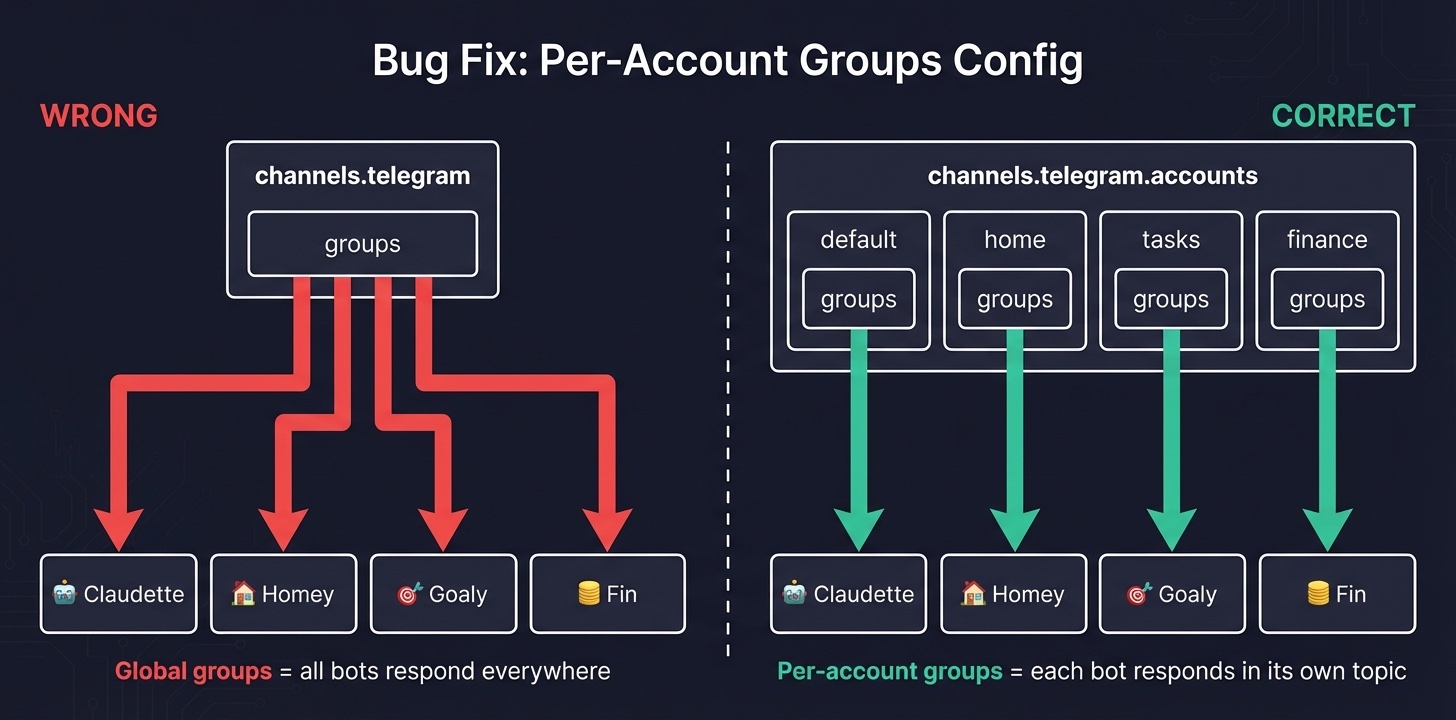
Bug 4: All Bots Responding in All Topics
Symptom: Sent a message in the Home topic. All four bots responded.This was the nastiest bug. The groups config was at the top level of channels.telegram, making it global across all bot accounts. Every bot saw every topic as "respond freely."
groups config INTO each channels.telegram.accounts.<id> section. Per-account, not global.
Bug 5: Inter-Agent Communication Failing
Symptom:Session Send: with label finance, timeout 30 failed:
No session found with label: financeThis had two independent causes:
Cause 1:tools.sessions.visibility defaults to "tree" — agents can only see their own session tree. Even with agentToAgent.enabled: true, agents couldn't find each other's sessions.
Cause 2: Target agents had never been activated. They had no main session to receive messages on.
Fixes:
- Set
sessions.visibility: "all"(the hidden requirement) - Seed each agent:
openclaw agent --agent <id> --message "System init"
openclaw agent --agent home --message \
  "Use sessions_send to send a message to the finance agent
   session key agent:finance:main. Say: Hey Fin, testing comms."
Fin replied: "Received loud and clear, Homey!"
Bug 6: Memory Files Pushed to Shared Repo
Symptom: The tasks-and-goals GitHub repo suddenly had Claudette's Home Assistant change logs, heating monitor data, and shopping list.When setting up Goaly, we copied Claudette's memory files into the workspace.
The .gitignore only excluded memory/heartbeat-state.json — not the entire memory/ directory. The git sync cron job (running every 15 minutes) auto-committed and pushed everything.
.gitignore to exclude all agent-specific files:
# Agent-specific (not shared)
memory/
SOUL.md
IDENTITY.md
AGENTS.md
TOOLS.md
USER.md
HEARTBEAT.md
MEMORY.md
config/mcporter.json
.openclaw/
.secrets/
Ran git rm --cached to untrack files while keeping them on disk. Pushed cleanup.
Warning
Lesson: When setting up auto-sync on a workspace that mixes shared and agent-specific files, get the
.gitignore right BEFORE the first sync runs.Git Sync for Shared Workspaces
Since Goaly's workspace is also used from other machines, we needed bidirectional sync. The solution: a cron-based script.
#!/bin/bash
# /usr/local/bin/openclaw-git-sync.sh
WORKSPACE="${1:?Usage: $0 /path/to/workspace}"
AGENT_NAME="${2:-openclaw}"

cd "$WORKSPACE" || exit 1

# Stash → pull --rebase → pop → add -A → commit → push
git stash
git pull --rebase origin main
git stash pop
git add -A

if ! git diff --cached --quiet; then
    git commit -m "sync: auto-commit from $AGENT_NAME"
    git push origin main
fi*/15 * * * * /usr/local/bin/openclaw-git-sync.sh /root/.openclaw/workspace-tasks goaly
Goaly's HEARTBEAT.md also includes a git sync check on each heartbeat (catches changes between cron runs) plus a Notion inbox check for overdue tasks.
The Final Architecture
Telegram Forum Supergroup
├─ General Topic     → All bots: @mention required
├─ 🏠 Home Topic     → Homey responds freely
├─ 📋 Tasks Topic    → Goaly responds freely
└─ 💰 Finance Topic  → Fin responds freely

Inter-agent communication (via sessions_send):
  Homey ↔ Goaly ↔ Fin ↔ Claudette

Workspaces:
  workspace/          → Claudette (general, default)
  workspace-home/     → Homey (HA tools, inherited memory)
  workspace-tasks/    → Goaly (Notion + Granola MCPs, git-synced)
  workspace-finance/  → Fin (basic, Xero pending)

Always-on:
  Heartbeats          → Sensor monitoring, anomaly detection
  Crons               → Scheduled rituals (inbox triage, weekly planning)
  Hooks               → Event-driven triggers (webhooks, notifications)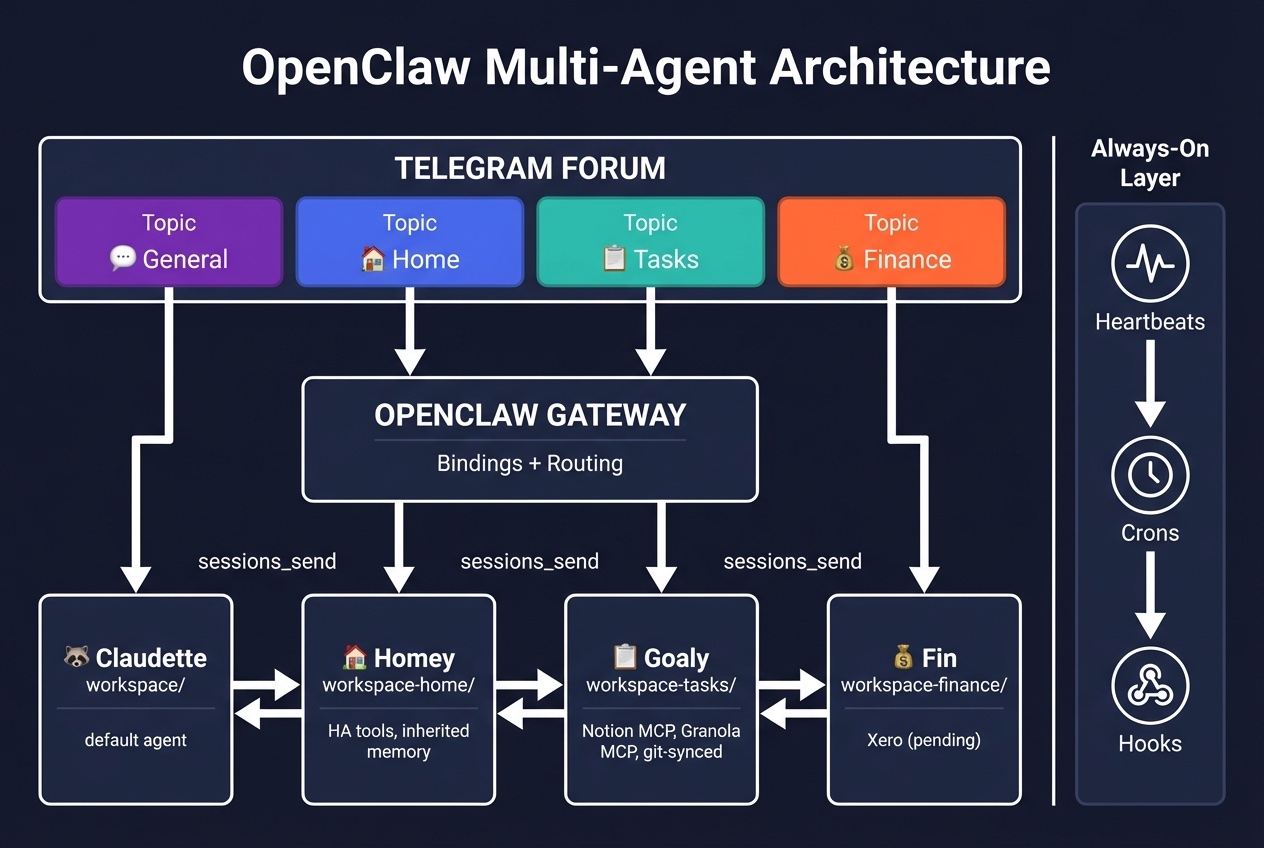
Key Takeaways
The eight things I wish I'd known before starting:
modelmust be an object, not a string —{ "primary": "provider/model" }- Always set
default: trueexplicitly on your main agent - Per-account
groupsconfig — never at the top-levelchannels.telegram sessions.visibility: "all"is the hidden requirement for inter-agent communication- Seed agent sessions before testing — agents need an active session to receive messages
- Get
.gitignoreright before auto-sync — agent memory and config must be excluded from shared repos - Copy memory for agents inheriting responsibilities — Homey got Claudette's full HA history, zero cold start
- Each agent needs clear boundaries in SOUL.md — personality AND handoff rules ("for finances, hand off to Fin")
What's Next
The team is running. Four agents, four topics, one forum. But this is just the foundation. The roadmap:
| Priority | What | Why |
|---|---|---|
| Now | Xero integration for Fin | Bookkeeping without spreadsheets |
| Now | Email triage via Goaly | Morning inbox summary at 8 AM |
| Next | Meeting prep automation | Goaly pulls Granola notes + Notion context before calls |
| Next | Monday morning planning ritual | Weekly priorities, overdue flags, client check-ins |
| Later | More agents | Research agent, content agent, client-specific agents |
| Later | MCPorter HTTP MCP validation | Confirm Goaly's Granola and Notion HTTP transports |
From one raccoon controlling my lights, to orchestrating agents with bash scripts, to exploring coordination dashboards, to persistent AI staff on Telegram. Each step taught me something about what actually matters in multi-agent systems.
Want this built for your business? I build systems like this as AI workflow automation projects — I set up the agents, connect your tools, and hand over a running system. Same setup, configured for your workflows.
The Bottom Line: Keep Claude Code for deep work. Add Telegram for reach. Add crons and heartbeats for persistence. Wire
sessions_send for cross-domain handoffs. Same context, three modes.Explore the Full Code
Star the repo to stay updated
Let's Connect
Follow for more smart home content
Follow on Twitter/X
@danmalone_mawla
Tags
ai
openclaw
multi-agent
telegram
claude
home-assistant

Related Articles
Continue reading similar content
I Replaced CleanShot X With a Free Screenshot App I Built in One Session
A free, open-source screenshot app for the Mac. I take screenshots all day, and that meant CleanShot X. This week I replaced it with FreeShot, which I built in one session with Claude Code. Here's what it took, what it cost and what I gave up.
5 min read
How to Make a SaaS Feel Alive: Intercom Lifecycle Messaging, Built with Claude
Most SaaS treats a new user like a transaction — a sign-up confirmation, then silence. Lifecycle messaging is how you make the product feel alive instead. Here's how I built a full system in Intercom — 37 outbound messages wired into four Series — by pointing Claude at Intercom's own internal API, plus the one rule most teams get wrong.
13 min read
Every Monday I Type /mission — 9 Claude Code Skills That Run My Business
I built 9 Claude Code skills to keep my one-person portfolio business oriented around goals, KPIs, and the actions that actually move them. Here's how the whole system works.
12 min read